Hazrat Masoumeh (s.a.)
Templat:شروع متن Templat:سوال Apakah punca kedudukan tinggi Hazrat Masoumeh (s.a.) di kalangan keturunan imam? Templat:پایان سوال Templat:پاسخ
Hazrat Masoumeh (s.a.) (173 - 201 H) adalah puteri kepada Imam Musa al-Kazim (a.s.), saudari kepada Imam Reza (a.s.) dan salah seorang wanita yang mulia dan terkenal di kalangan Syiah.
Nama asalnya adalah Fatimah dan antara gelaran terkenalnya ialah Masoumeh, Karimeh Ahlul Bait, Shafie'ah, dan Tahereh. Dalam hadis-hadis, beliau diberikan kedudukan syafaat, Ismah (kemaksuman) dan kedudukan ilmiah. Imam Reza (a.s.) menganggap pahala menziarahi makam saudarinya sama seperti pahala menziarahi makamnya sendiri. Banyak riwayat dari ulama Syiah mengenai kemuliaan dan keutamaan Fatimah Masoumeh (s.a.).
Antara peristiwa penting dalam kehidupan Fatimah Masoumeh (s.a.) adalah perjalanannya ke Iran untuk bertemu abangnya, Imam Reza (a.s.). Dalam buku-buku Syiah disebutkan bahawa dalam perjalanan ini, di kota Saveh, kafilah mereka diserang dan beberapa anggota kafilahnya terbunuh. Fatimah Masoumeh (s.a.) jatuh sakit selepas kejadian ini dan meninggal dunia setelah tiba di Qom.
Makam Fatimah Masoumeh (s.a.) terletak di Kota Qom. Pada mulanya, makamnya adalah kubur yang sederhana. Makam ini telah diperluas pada zaman pemerintahan yang berbeza, terutamanya pada zaman pemerintahan Syiah. Puncak pengembangan makam Fatimah Masoumeh (s.a.) adalah pada zaman Safawiyah dan selepasnya.
Kedudukan
Fatimah Masoumeh (s.a.) dianggap sebagai salah seorang keturunan imam yang paling mulia di kalangan Syiah.[1] Beliau adalah puteri Imam Musa al-Kazim (a.s.), saudari Imam Reza (a.s.) dan makcik kepada Imam Jawad (a.s.). Makamnya di kota Qom dianggap sebagai makam Ahlul Bait (a.s.) kedua di Iran, selepas makam Imam Reza (a.s.) di Mashhad.[2]
Keutamaan
Fatimah Masoumeh (s.a.) dianggap memiliki kedudukan Syafaat.[3] Imam Ja'far al-Sadiq (a.s.) menganggap syafaat Fatimah Masoumeh (s.a.) sebagai penyebab masuknya Syiah ke syurga.[4] Sesetengah pihak, berdasarkan riwayat ini, menganggap syafaat Fatimah Masoumeh (s.a.) sangat luas.[5]
Sesetengah pihak, berdasarkan sebahagian daripada Ziaratnameh Fatimah Masoumeh (s.a.), menganggap beliau sebagai puteri roh dan jasad Nabi Muhammad (s.a.w.), Hazrat Zahra (s.a.), Khadijah al-Kubra (s.a.) dan para Imam Maksum (a.s.).[6] Selain itu, dari bahagian lain Ziaratnameh ini, kedudukan Ismah (kemaksuman) telah dibuktikan untuk Fatimah Masoumeh (s.a.).[7]
Keberkatan dan keutamaan yang berkaitan dengan tanah dan ziarah beliau adalah aspek lain dari keutamaan Fatimah Masoumeh (s.a.). Dalam beberapa riwayat, pahala menziarahi Fatimah Masoumeh (s.a.) dianggap syurga.[8] Banyak riwayat dari ulama Syiah mengenai kemuliaan dan keutamaan Hazrat Fatimah Masoumeh (s.a.) telah disebutkan[9]. Sebagai contoh, disebutkan bahawa Mulla Sadra, seorang ahli falsafah Syiah yang meninggal dunia pada tahun 1050 H, sering menziarahi beliau dan bertawassul kepadanya untuk menyelesaikan masalah ilmiah dan falsafahnya.[10] Selain itu, Sheikh Abbas Qomi (1294-1359 H), seorang muhaddith dan sejarawan Syiah, memanggil Fatimah Masoumeh (s.a.) sebagai Sayyidah Jalilah dan puteri Imam Musa al-Kazim (a.s.) yang paling mulia.[11] Banyak karamah telah disebutkan dalam sumber-sumber mengenai ziarah dan makam beliau.[12]
Ilmu
Fatimah Masoumeh (s.a.) dianggap sebagai salah seorang wanita yang berilmu dan perawi hadis.[13] Para muhaddith Syiah dan Ahlus Sunnah telah meriwayatkan hadis-hadis yang dinukil dari Fatimah Masoumeh dalam sumber-sumber mereka. Antara riwayat-riwayat ini adalah:
1. Muhammad bin Muhammad Jazari (751-833 H), seorang muhaddith dan fuqaha Syafie, meriwayatkan melalui Fatimah Masoumeh (s.a.) dan beliau melalui puteri-puteri maksum (a.s.), seperti Sakinah puteri Imam Husain (a.s.) dan Ummu Kultsum puteri Imam Ali (a.s.), dari Fatimah Zahra (s.a.) bahawa beliau berkata: Templat:Teks Arab[14]
2. Bakr bin Ahmad meriwayatkan dari Fatimah puteri Imam Reza (a.s.) dan beliau dari Fatimah Masoumeh (s.a.) dan beliau melalui puteri-puteri maksum (a.s.) dari Fatimah Zahra (s.a.) bahawa Rasulullah (s.a.w.) berkata bahawa pada hari kiamat semua orang akan dipanggil dengan nama ibu mereka kecuali Syiah Ali bin Abi Talib (a.s.).[15]
Gelaran
Templat:Lihat juga Banyak gelaran telah disebutkan untuk Hazrat Masoumeh (s.a.) dalam sumber-sumber: Antaranya ialah gelaran Tahereh (suci), Hamidah (terpuji), Birrah (baik hati), Rashidah (matang), Taqiyyah (bertakwa), Radhiyah (redha dengan Allah), Mardhiyyah (diredhai Allah), Naqiyyah (bersih), Ukht al-Reza (saudari Imam Reza), Sayyidah Siddiqah (wanita yang sangat jujur), Sayyidah Radhiyyah Mardhiyyah (wanita yang redha dengan Allah dan diredhai-Nya), Muhaddithah (perawi hadis), Abidah (penyembah) dan Sitti (tuan) boleh disebutkan.[16]
Masoumeh adalah antara gelaran terkenal puteri Imam Kazim (a.s.). Gelaran ini diambil dari riwayat yang dinukil dari Imam Reza (a.s.):Templat:Teks Arab Gelaran Masoumeh, walaupun tidak menunjukkan Ismah (kemaksuman) pada tahap kemaksuman para maksum (a.s.), ia menunjukkan beliau memiliki tahap yang lebih rendah dalam kedudukan kemaksuman; tahap yang tidak terdapat pada manusia biasa.[17]
Antara gelaran lain Hazrat Masoumeh (s.a.) ialah Karimeh Ahlul Bait. Mar'ashi Najafi (1276-1369 S.H.), seorang marja' taqlid Syiah, berkata bahawa Imam Muhammad al-Baqir (a.s.) atau Imam Ja'far al-Sadiq (a.s.) telah berkata kepada bapanya dalam mimpi: "Hendaklah kamu kepada Karimeh Ahlul Bait."[18] Shafie'ah adalah antara gelaran lain Fatimah Masoumeh (s.a.). Dari Imam Sadiq (a.s.) diriwayatkan: Templat:Teks Arab[19]
Biography
There is not much information available about the life of Lady Ma'sumah (s.a.); including details about her birth and death dates and the specifics of her life.[20] According to some later sources, her birth occurred in 173 AH, during the caliphate of Harun al-Rashid, in Medina. Fatimah Ma'sumah lost her father, Imam Kadhim (a.s.), at the age of ten.[21] Fatimah Ma'sumah's (s.a.) father was Imam Musa Kadhim (a.s.), the seventh Imam of the Shi'ites, and her mother, Najmah, was a virtuous lady. Shaykh Saduq narrated that Najmah Khatun was known for her intellect, wisdom, obedience, worship, and adherence to etiquette. Historical sources explicitly state that Imam Reza (a.s.) and Lady Ma'sumah (a.s.) shared the same mother.[22]
Lady Ma'sumah (s.a.) never married during her lifetime. Some attribute her not marrying to not finding an equal or someone worthy of her.[23] One of the mentioned possibilities regarding her not marrying is that Imam Kadhim (a.s.) himself advised his daughters not to marry. Opponents of this claim have rejected such a will, considering it contrary to the tradition of the Messenger of Allah (s.a.w.) and the practice of the Ahl al-Bayt (a.s.). Some have also said that the severe oppression during the time of Harun and Ma'mun al-Abbasi made it difficult for anyone to easily visit Musa ibn Ja'far's house and become a son-in-law to that family. Furthermore, the imprisonment of Lady Musa ibn Ja'far (a.s.), his martyrdom in prison, the summoning of Imam Reza (a.s.) to Khorasan, and the Imam's separation from his sisters added to this reason.[24]
Journey to Iran and Demise
The author of Tarikh Qom (History of Qom) states that in 200 AH, Ma'mun, the Abbasid Caliph, summoned Imam Reza (a.s.) from Medina to Marv to appoint him as his successor. The Imam's sister, Fatimah Ma'sumah (s.a.), set out for Iran in 201 AH with the intention of visiting her brother. It is said that Lady Fatimah Ma'sumah (s.a.) had prepared herself for the journey after receiving her brother's letter.[25]
Fatimah Ma'sumah (s.a.) traveled towards Tus in Iran in 201 AH. On this journey, five of Fatimah Ma'sumah's (s.a.) brothers, namely Fadl, Ja'far, Hadi, Qasim, and Zayd, along with several of her nephews and some servants, accompanied her. According to some, Fatimah Ma'sumah (s.a.) traveled with 23 of her brothers and nephews. Others have said that Lady Ma'sumah (s.a.) was accompanied by only one servant on this journey.[26] Fatimah Ma'sumah (a.s.) endured the hardships of this long journey until she reached the city of Saveh. The people of that city, who were enemies of the Ahl al-Bayt (a.s.) at that time, attacked her caravan. A fierce battle ensued, and all of her brothers and nephews were martyred. The grief of the martyrdom of 23 relatives eventually led Fatimah Ma'sumah to her sickbed. The people and nobles of Qom, who loved the Prophet's (s.a.w.) household, upon learning of this event, went to Saveh and, after meeting Fatimah Ma'sumah (s.a.), took her to Qom at her request. Fatimah Ma'sumah spent seventeen days in the house of one of the prominent figures of Qom, named Musa ibn Khazraj Ash'ari, while she was ill. Finally, Fatimah Ma'sumah (s.a.) passed away on the tenth of Rabi' al-Thani in 201 AH in the city of Qom.[27]
The exact date of Fatimah Ma'sumah's (s.a.) demise is not mentioned in early sources; however, later sources state her death anniversary as the tenth of Rabi' al-Thani in 201 AH, at the age of 28. Some have also recorded the twelfth of Rabi' al-Thani. Some researchers believe that both dates are estimations.[28] According to another report, after that attack in Saveh, enemies poisoned Fatimah Ma'sumah's (s.a.) food, and that poison caused her illness and ultimately her martyrdom after seventeen days.[29]
Some have said that given the military conflict with Fatimah Ma'sumah's (s.a.) caravan, her martyrdom was probable; because her illness was affected by this war. The report in Tarikh Qom, stating Fatimah Ma'sumah's (s.a.) demise due to illness, can be interpreted as reflecting the conservative stance of the dominant Ash'aris who tried to maintain their relationship with the Abbasid government. The author of Tarikh Qom was one of the Ash'aris.[30]
Pilgrimage Prayer and Reward of Pilgrimage
Templat:Main article The pilgrimage to Lady Masuma holds a special status in the words of the Ahl al-Bayt, and narrations have been issued regarding its importance. These narrations speak of the reward for her pilgrimage.[31]
- Sa'd ibn Sa'd asked Imam Reza (AS) about the pilgrimage of Fatima, daughter of Musa? The Imam said: Templat:Arabic text[32] [33]
- Imam Jawad (AS) said regarding the virtue of visiting the grave of his aunt: Templat:Arabic text[34]
Pilgrimage Prayer
Allameh Majlesi in his book Bihar al-Anwar and some other works has narrated a pilgrimage prayer for Lady Masuma.[35] which is recited today beside her shrine.
This pilgrimage prayer begins with divine invocations. First, near the grave and facing the Qibla, one should recite 34 times "Allahu Akbar", 33 times "Subhanallah", and 33 times "Alhamdulillah", and then the text of the pilgrimage prayer is recited.[36]
Templat:Collapsible dual quote
Shrine
According to historical sources, Fatima Masuma (SA) was buried in the Baghe Babilan neighborhood of Qom.[37] Initially, a mat was placed over her grave.[38] After that, the shrine of Lady Masuma (SA) underwent many changes and developments throughout history and expanded in different periods.[39] The construction of the mausoleum of Fatima Masuma (SA) began in the mid-3rd century AH, and throughout the 4th to 6th centuries, it had a dome and cupola with decorations.[40] However, until the Safavid era, there was no magnificent zarih (enclosure) or iwan (portico) for the shrine.[41]
During the Safavid period, the shrine was expanded, including the construction of the Atiq Courtyard and the Golden Iwan.[42] The expansion of the shrine continued during the Qajar period. Fath-Ali Shah Qajar paved the shrine's floor with marble. According to an inscription in the shrine, the mirror work on the shrine's walls also began during Fath-Ali Shah's reign and was completed during Mohammad Shah's time.[42] During the reign of Naser al-Din Shah Qajar, the Atabak Courtyard was also built.[43] After the Islamic Revolution of Iran, the shrine was further expanded, and sections such as the Imam Khomeini Shabestan (prayer hall) were added to the shrine.[44]
After the Islamic Revolution of Iran, the shrine was also expanded, and sections such as the Imam Khomeini Shabestan were added to the shrine.[44]
Courtyards and Porticoes
The shrine of Lady Masuma (SA) has several courtyards:
- The Atiq Courtyard, which is called the Small Courtyard, the Old Courtyard, and today the Imam Hadi (AS) Courtyard. This courtyard is square-shaped and has three iwans. The Golden Iwan is located in this courtyard.[45]
- The Atabaki Courtyard, which is called the New Courtyard and today the Imam Reza (AS) Courtyard. This courtyard was built during the reign of Naser al-Din Shah Qajar by Mirza Ali Asghar Khan Atabak. The Mirror Portico, which was built in 1130 AH by the order of Ali Akbar Khan Atabak, is located in this courtyard.[46]
- The Saheb al-Zaman (AS) Courtyard, which has an area of about 8000 square meters and has four entrances. This courtyard is located next to the Imam Khomeini Shabestan.[44]
- The Jawad al-A'immah (AS) Courtyard; this courtyard, which has an area of more than 15000 square meters, was built on the Qomrud River. This courtyard, with four main entrances and two emergency entrances, was built in the late 2000s.[47]
- The Prophet Azam (SA) Courtyard; the construction of this courtyard began in the late 2000s.[48]
There are six porticoes in the shrine of Lady Masuma (SA), most of which have a smaller dome than the main dome of the shrine. Three porticoes were built by the Safavids, two by the Qajars, and one belongs to the contemporary era.[49]
Zarih (Enclosure)
The first zarih of Lady Masuma's shrine (SA) was built by Shah Tahmasp I. Shah Tahmasp later installed another zarih made of white and transparent steel around the previous one. This zarih was replaced in 1000 AH by Shah Abbas I Safavid with another zarih. Fath-Ali Shah Qajar covered this zarih with silver plates in 1245 AH and placed it on a marble base. After some renovations, its shape was finally changed in 1348 SH, and its height was increased.[50] In 1380 SH, the zarih of Lady Masuma (SA) was completely renovated.[51]
Dome
The first dome over the tomb of Lady Masuma was built by a woman named Zaynab,[52] whom some have identified as the daughter of Imam Jawad (AS).[53] "Amir Abul-Fadl Iraqi", the ruler of Qom during the Seljuk period, built a new dome.[54] In 925 AH, Shah Begum Safavi demolished this dome and built another dome, which remains today. This dome was decorated with 12,000 gold bricks in 1518 AH by the order of Fath-Ali Shah. The height of this dome from the roof of the shrine is 16 meters and from the ground is 32 meters.[55] The dome was renovated in the 2000s during the Islamic Republic era.[56]
Minarets
- Two minarets are located in the Atabaki Courtyard, which are among the tallest structures of the shrine and are situated above the Mirror Iwan.
- Two minarets are located on the other side of the Atabaki Courtyard, opposite the Mirror Iwan.
- Two minarets were built in the Golden Iwan in the Atiq Courtyard, covered with spiral knot tiles.[57]
Gallery
-
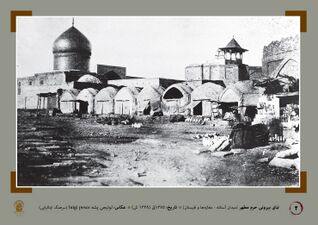 Exterior view of the Holy Shrine of Fatimah Ma'sumah (S.A.) from Astaneh Square (1859 CE).
 -
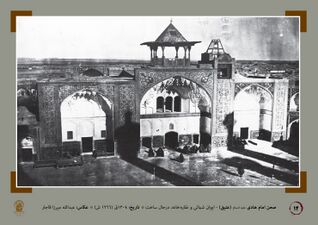 Atiq Courtyard and Naqqareh Khaneh (1887 CE).
 -
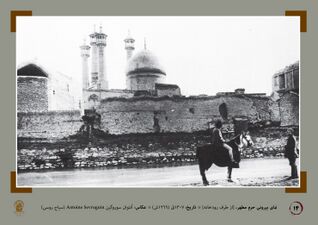 Exterior view of the Holy Shrine of Fatimah Ma'sumah (S.A.) from Qom River and the high walls built to prevent floods from entering the shrine (1890 CE).
 -
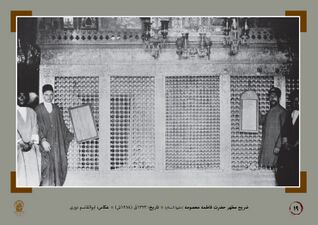 Zarih (enclosure) of the tomb of Fatimah Ma'sumah (S.A.) (1905 CE).
 -
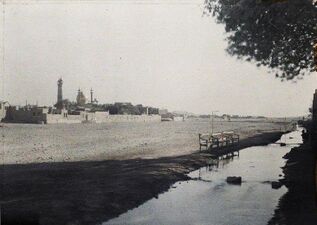 Panoramic view of the Holy Shrine of Fatimah Ma'sumah (S.A.) (1927 CE).
 -
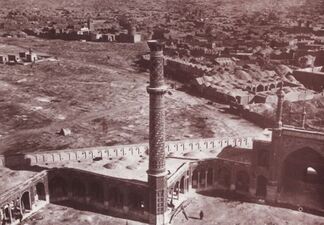 A view of a part of Atabaki Courtyard.
 -
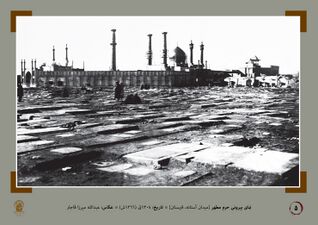 Exterior view of the Holy Shrine of Fatimah Ma'sumah from Astaneh Square (1887 CE).
 -
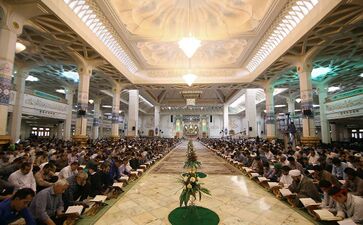 Collective Quran recitation in Imam Khomeini Shabestan of the Holy Shrine of Fatimah Ma'sumah (S.A.).
 -
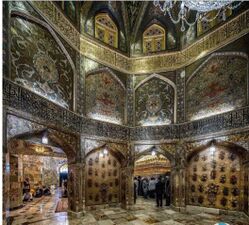 A view of one of the porticos of the Holy Shrine of Fatimah Ma'sumah (S.A.).
 -
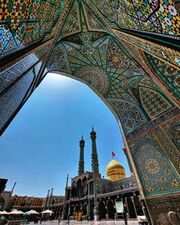 A view of the dome and minarets of Atabaki Courtyard of the Holy Shrine of Fatimah Ma'sumah (S.A.).


References
- ↑ Qomi, Abbas bin Mohammad Reza, Montahal Amal fi Tarikh al-Nabi wa al-Al, Qom, Daftar Nashr Islami, jilid 2, hlm. 378.
- ↑ Eshaqi, Seyyed Hossein, Mahtab Ahlul Bait (Sirri dar Zendegi Karimeh Ahlul Bait Hazrat Masoumeh), Qom, Markaz Pazhouheshhaye Islami Seda va Sima, 1386 S.H., hlm. 3-6.
- ↑ Mohammadi Eshtehardi, Mohammad, Hazrat Masoumeh (s.a.) Fatimah Kedua, Qom, Nashr Akhlaq, 1380, hlm. 178-179.
- ↑ Al-Majlisi, Bihar al-Anwar al-Jami'ah li Durar al-Akhbar al-Aimmah, Beirut, Dar Ihya al-Turath al-Arabi, 1403 H, jilid 57, hlm. 228.
- ↑ Mohammadi Eshtehardi, Hazrat Masoumeh (s.a.) Fatimah Kedua, hlm. 178-179.
- ↑ Mohammadi Eshtehardi, Mohammad, "Hazrat Masoumeh (s.a.), Akhtar Tabaan Al Muhammad (s.a.w.)", Nashriyeh Pasdar Islam, no. 177, 1357.
- ↑ Mohammadi Eshtehardi, Hazrat Masoumeh (s.a.) Fatimah Kedua, hlm. 159.
- ↑ Ibn Qulawayh, Ja'far bin Mohammad, Kamil al-Ziyarat, tahqiq Abd al-Hussein Amini, Najaf, Dar al-Murtadawiyah, hlm. 324.
- ↑ Untuk maklumat lanjut, lihat: Mohammadi Eshtehardi, Mohammad, "Hazrat Masoumeh (s.a.), Akhtar Tabaan Al Muhammad (s.a.w.)".
- ↑ Qomi, Abbas bin Mohammad Reza, al-Fawaid al-Radawiyah fi Ahwal Ulama al-Mazhab al-Ja'fariyah, tahqiq Nasser Baqeri Bidehndi, Qom, Boostan Kitab, 1385, hlm. 618.
- ↑ Qomi, Montahal Amal, jilid 2, hlm. 378; juga: Qomi, Abbas bin Mohammad Reza, Mafatih al-Jinan, Qom, Intisharat Osvah, tanpa tarikh, hlm. 562.
- ↑ Untuk maklumat terperinci, lihat: Mohammadi Eshtehardi, Hazrat Masoumeh (s.a.) Fatimah Kedua, hlm. 191-219.
- ↑ Sadeghi Ardestani, Ahmad, Zanan Daneshman va Rawi Hadith, Qom, Markaz Intisharat Daftar Tablighat Islami, 1377, hlm. 350-351.
- ↑ Ibn al-Jazari, Muhammad bin Muhammad, Asna al-Matalib fi Manaqib al-Imam Ali (a.s.), Isfahan, Maktabah al-Imam Amir al-Mu'minin Ali (a.s.) al-Ammah, hlm. 50-51.
- ↑ Al-Qomi, Abbas bin Mohammad Reza, Safinah al-Bihar wa Madinah al-Hikam wa al-Athar, Tehran, Dar al-Usrah li al-Tiba'ah wa al-Nashr, 1392, jilid 4, hlm. 545.
- ↑ Na'ini Ardestani, Mohammad Ali bin Hussein, Anwar al-Musha'sha'in, tahqiq Mohammad Reza Ansari Qomi, Qom, Ketabkhaneh Bozorg Hazrat Ayatollah al-Uzma Mar'ashi Najafi, jilid 1, hlm. 211; juga: Rafiei, Ali, Tarikh Zendegani Imam Kazim (a.s.), Tehran, Sepah Pasdaran Enghelab Islami, Namayandegi Vali Faqih, Edareh Amoozeshhaye Aqidati Siyasi, hlm. 21.
- ↑ Rafiei, Tarikh Zendegani Imam Kazim (a.s.), hlm. 21.
- ↑ Rafiei, Tarikh Zendegani Imam Kazim (a.s.), hlm. 21.
- ↑ Rafiei, Tarikh Zendegani Imam Kazim (a.s.), hlm. 21.
- ↑ Mahallati, Rayahin al-Shari'ah, vol. 5, p. 31.
- ↑ From Birth to Death, Comprehensive Portal of the Holy Shrine of Lady Fatimah Ma'sumah (s.a.), date of publication: 1398, date of visit: 1401.
- ↑ A group of authors, Encyclopedia of Imam Kadhim (a.s.), no place, Ashura Specialized Website, no date, p. 338.
- ↑ Elhami, Davood, A Journey Through the History of Shi'ism, Qom, Maktab Islam, 1375, p. 545.
- ↑ Hosseini, Seyyed Javad, "The Secret of Lady Ma'sumah's (s.a.) Non-Marriage," Farhang Kowsar, 1386, no. 69.
- ↑ Faghihi, Ali-Asghar, Tarikh Madhhabi Qom, Qom, Zayer Publications, 1387, p. 92.
- ↑ From Birth to Death, Comprehensive Portal of the Holy Shrine of Lady Fatimah Ma'sumah (s.a.), date of publication: 1398, date of visit: 1401.
- ↑ Rafiei, Tarikh Zendegani Imam Kadhim (a.s.), pp. 24-25.
- ↑ 23rd of Rabi' al-Awwal, the anniversary of the arrival of Lady Fatimah Ma'sumah (s.a.), Library of Faqahat School, date of publication: 1396, date of visit: 1401.
- ↑ Tashid, Ali-Akbar, Hadiyeh-ye Isma'il or the Uprising of the Alawi Sayyids for the Caliphate, Tehran, Dar al-Kutub al-Islamiyah, 1385 SH, p. 166.
- ↑ Pak, Mohammad Reza, "Qom in the First Two Centuries of Hijra," Tarikh Islam, Islamic Propaganda Office of Qom Seminary, 1382, no. 14, p. 10.
- ↑ Templat:Journal citation
- ↑ Ibn Qulawayh, Ja'far ibn Muhammad, Kamil al-Ziyarat, Najaf Ashraf, Dar al-Murtadawiyah, first edition, 1356 AH, Chapter 106, p. 324, Hadith 1.
- ↑ Ibn Babawayh, Muhammad ibn Ali, Uyun Akhbar al-Reza (peace be upon him), Tehran, Nashr Jahan, first edition, 1378 AH, Chapter 67, vol. 2, p. 267, Hadith 1.
- ↑ Ibn Qulawayh, Ja'far ibn Muhammad, Kamil al-Ziyarat, Najaf Ashraf, Dar al-Murtadawiyah, first edition, 1356 AH, Chapter 106, p. 324, Hadith 2.
- ↑ Al-Majlesi, Bihar al-Anwar, vol. 99, pp. 266-267; also: Al-Majlesi, Muhammad Baqir, Tuhfat al-Za'ir, Qom, Imam Hadi (AS) Institute, 1386 AH, p. 4; also: Al-Majlesi, Zad al-Ma'ad, Beirut, Mu'assasat A'lami lil-Matbu'at, 1423 AH, pp. 547-548.
- ↑ Al-Majlesi, Bihar al-Anwar, vol. 99, pp. 266-267.
- ↑ Kiani, Yousef, "The Complex of Lady Masuma's Shrine (SA)", Faculty of Literature and Humanities, University of Tehran, No. 151, Autumn 1999, p. 64.
- ↑ Sajjadi, Sadegh, "The Shrine of Lady Masuma", The Great Islamic Encyclopedia, Tehran, Center for the Great Islamic Encyclopedia, vol. 1, p. 360.
- ↑ Sajjadi, "The Shrine of Lady Masuma", The Great Islamic Encyclopedia, vol. 1, pp. 358-362.
- ↑ Sotoudeh, Manouchehr, Books of the Holy Shrine of Lady Masuma (SA) and its surrounding courtyards, Qom, Library of Grand Ayatollah Marashi Najafi, 1375 AH, p. 19.
- ↑ Rezaei Nodushan, "The Evolution of Lady Masuma's Shrine (SA)", Iranian Architectural Studies, p. 92.
- ↑ 42.0 42.1 Sajjadi, "The Shrine of Lady Masuma", The Great Islamic Encyclopedia, vol. 1, p. 359.
- ↑ Vazin Afzal, Mehdi, "The Expansion of Lady Masuma's Shrine and the Increase of Pilgrims to Qom during Naser al-Din Shah's Reign", Research in History, Year 2, No. 3, Autumn 2011, p. 65.
- ↑ 44.0 44.1 44.2 "Lady Masuma's Shrine", Reisen Iran website, article date: June 3, 2022, access date: January 4, 2023.
- ↑ Sajjadi, "The Shrine of Lady Masuma", The Great Islamic Encyclopedia, vol. 1, p. 360.
- ↑ Sajjadi, "The Shrine of Lady Masuma", The Great Islamic Encyclopedia, vol. 1, pp. 360-361.
- ↑ "Lady Masuma's Shrine" Reisen Iran website.
- ↑ "Lady Masuma's Shrine" Reisen Iran website.
- ↑ Sajjadi, "The Shrine of Lady Masuma", The Great Islamic Encyclopedia, vol. 1, pp. 360-361.
- ↑ Sajjadi, "The Shrine of Lady Masuma", The Great Islamic Encyclopedia, vol. 1, pp. 359-360.
- ↑ "Historical overview of the holy zarih of Lady Masuma (SA) from beginning to present", ISNA, article date: August 10, 2016, access date: January 1, 2023.
- ↑ Sajjadi, "The Shrine of Lady Masuma", Center for the Great Islamic Encyclopedia, vol. 1, p. 360.
- ↑ Nodushan, Mohammad Rezaei, "The Evolution of Lady Masuma's Shrine (SA)", Iranian Architectural Studies, No. 16, Autumn and Winter 2019, p. 92.
- ↑ ""The Holy Shrine of Lady Masuma (AS) (Qom)", Islamic Knowledge (Endowments Organization), No. 29, September 1978, p. 56.
- ↑ Sajjadi, "The Shrine of Lady Masuma", The Great Islamic Encyclopedia, vol. 1, p. 360.
- ↑ Faqih Mirzayi, Hossein, "Reconstruction plan for the holy dome of Lady Fatima Masuma's shrine (SA)", Hawzah Information Base, article date: April 21, 2003, access date: January 3, 2023.
- ↑ "History of Lady Masuma's Shrine (SA)", Hawzah Information Base, article date: July 15, 2018, access date: January 1, 2023.